
What a key is made of
A key for a cylinder lock has two jobs, and its shape reflects both. The first job is to get into the lock at all. The second is to set every part inside the lock to the right position once it is in.
- The bow is the part you hold. It does no work inside the lock.
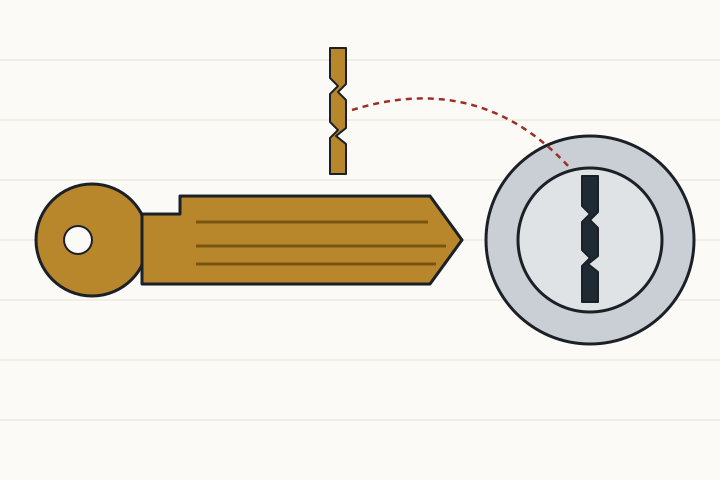
- The blade is the part that goes in. Its cross-section, the shape you would see if you cut it straight across, has to match the slot in the lock.
- The cuts along the edge of the blade, together called the bitting, are what set the pins or wafers. Each cut sits under one pin stack or one wafer when the key is fully inserted.
The two jobs are handled by different features. The cross-section decides whether the key enters. The cuts decide whether it turns. A key can have the right cuts and still not go in, or go in and still not turn.
Key blanks
Every key starts as a blank: a key with the right bow and the right blade profile but no cuts yet. The profile is made by milling grooves along the length of the blade on one or both sides. Those grooves are what let the blank slide past the ridges inside a particular keyway.
Linus Yale, Jr.'s 1865 patent describes a thin steel key in a narrow slit, and the Lemelson-MIT Program describes his key as small and flat with serrated edges. Modern blanks keep the flat blade but add the milled profile. A wafer lock key works the same way: the patent for the wafer lock discussed in the previous guide describes an ordinary key whose cuts set each wafer.
Because the profile is part of the blank and the cuts are added afterwards, the same blank can become many different keys. That is why the blank is a useful point of control, as the rest of this guide explains.
Keyways and wards
The keyway is the slot in the face of the plug. Looked at end on, it is not a plain rectangle: its outline steps in and out. The parts of the plug that stick into the slot are called wards. A blank enters only if its milled grooves line up with the wards along its whole length.
A patent for a restricted key system, US5176015, filed in 1991, gives a clear background account. It describes common warded key slots designed for flat keys milled on both sides, where the ward pattern in the slot mirrors the milling on the keys. Different ward patterns accept different blanks, so the keyway acts as a first filter before the pins are even reached.
In one line
The keyway decides which blanks can enter; the cuts decide which of those keys can turn.
Master key systems
Large buildings often need some keys that open only one door and others that open many. The same patent describes one way keyways help with that. Each tenant's lock has a keyway whose wards accept only that tenant's blank. A master key is made on a thinner blank milled so that it can pass the wards of several different slots.
That arrangement has a cost, and the patent is frank about it. Because master blanks have to fit many slots, a master blank that can be bought freely is also a blank that can enter many locks. The patent's background says such blanks were often stocked by hardware stores. This is one reason organizations that run master key systems care about who can obtain blanks, not just about the locks themselves.
Key control and copies
Key control means knowing who holds which keys and being able to limit copies. The restricted key system patent describes the problem from the point of view of large institutions such as universities and hospitals: when blanks are sold without restriction and can be cut on common key machines, anyone holding a key can have a copy made, and the institution loses track of how many keys exist.
Its proposed answer, and the general idea behind restricted keyways, is a profile that is hard to reproduce on standard equipment, with blanks distributed only through the maker. The details of any particular restricted system are commercial and change over time, so this site does not compare them. The principle is enough to explain why some keys are easy to copy and others are not: the difference is mostly in the blank, not the cuts.
For a household, key control usually means something simpler: knowing how many copies of each key exist and who has them. That knowledge matters most when a key goes missing, as the lost keys guide explains.
Looking after your own keys
Police burglary prevention advice is direct about spare keys. The Summit Police Department in New Jersey advises never leaving keys under doormats, flowerpots, mailboxes or other hiding places, because burglars know where to look. The same bulletin advises changing locks straight away if keys are lost or stolen, and having all the locks changed when moving into a new home, since there is no way to know how many keys a previous occupant handed out.
Those two pieces of advice follow directly from how keys work. A lock cannot tell the difference between its owner's key and a copy, and a hidden key is simply a copy that anyone can find.
Example: one building, many keyways
Worked example
This is an illustration of the principle described in the patent, not a description of any real building or product.
- An office building has four floors. The locks on each floor use a different keyway, so a key milled for the first floor will not enter a lock on the second.
- Within each floor, every door has different cuts, so a key for one office does not turn the lock of the office next door.
- The building manager holds a master key made on a thinner blank that passes the wards of all four keyways, and its cuts are set up to work with every lock in the system.
- If an office key is lost, only one lock is at stake. If the master key is lost, every lock in the building is, which is why master keys are issued to as few people as possible.
Where this guide stops
This guide explains what blanks and keyways are and why they matter for key control. It does not explain how to copy, cut or alter keys, does not give key cutting measurements or codes, and does not identify blanks for particular locks. The next guide moves from house keys to car keys, where an electronic check sits alongside the mechanical one.
Next explainer: Car locks and transponder keys, in general terms