
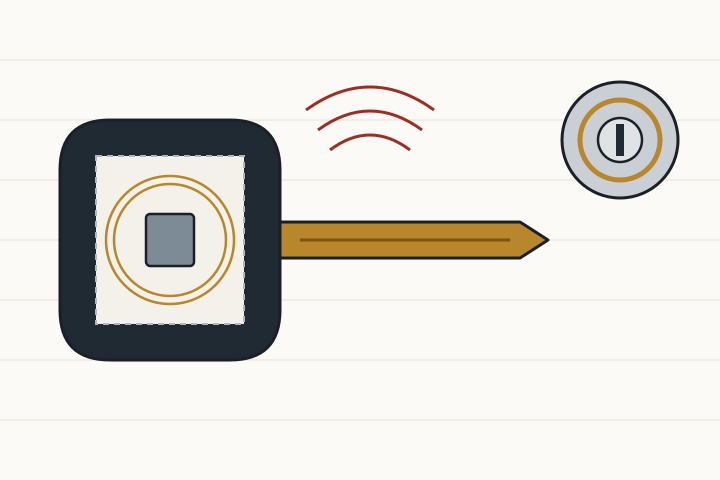
Two checks, not one
A house key does one thing: it lines up the parts of a mechanical lock. A modern car key often has to pass two separate checks. The first is mechanical, and works on the same principles as the locks in the earlier guides: the blade has to fit and set a lock. The second is electronic. The car has to recognize a signal before the engine is allowed to run.
This guide explains that second check at a general level, using a US Department of Justice library record of an engine immobilizer study and the text of a US federal regulation. It does not go into how particular systems encode their signals, which varies by maker and model and is outside the scope of this site.
What an immobilizer does
An engine immobilizer is an electronic device that controls part of what the engine needs to run. The study abstract held in the Office of Justice Programs' National Criminal Justice Reference Service library describes it as acting on the ignition system, the fuel system, the starter, or a combination of the three.
The key point is what happens by default. The immobilizer does not let the vehicle start until it has received the correct signal from the person trying to start it. Without that signal, turning the key or pressing the start button does not run the engine, even if the mechanical lock has been opened.
That is the same idea as a lock with an extra sidebar or a second row of pins, carried into electronics: one more condition that has to be met at the same time as the others.
How the signal reaches it
The same abstract lists several ways the correct signal can reach the immobilizer: a transponder, a remote key, an electronic key, a coded keypad or a key switch. It describes a transponder as an electronic proximity device that turns electronically coded signals into radio signals, and it reports that the transponder approach was favored by makers of newer immobilizers and generally seen as the hardest to defeat.
In everyday terms, this is what people mean by a chip key or transponder key: the part that matters is a small electronic device carried with the key, close enough to the vehicle to send its coded signal when the driver tries to start it. The metal blade, if there is one, is still there to work the mechanical locks.
In one line
The blade opens the lock; the coded signal lets the engine start. A car with an immobilizer needs both.
What a study found
The study, Engine Immobilisers: How Effective are They?, was published in 2001 by Australia's National Motor Vehicle Theft Reduction Council and is catalogued in the US Department of Justice library. Its abstract reports three findings that are useful to understand, even though the data come from Australia and are now old.
- Vehicles with immobilizers were much less likely to be stolen than comparable vehicles without them.
- Immobilizers reduced opportunistic theft more than professional theft. Rates of theft for immobilized vehicles were lower in states with less professional theft, and the authors concluded that other strategies are needed against professional thieves.
- Systems that met the Australian Standard, such as encrypted types, were the best deterrents. Systems with weaker designs gave less protection, but still did better than no immobilizer at all.
The honest summary is that an immobilizer is a strong extra check, not a guarantee. That matches what the earlier guides say about mechanical locks: each extra condition makes the wrong attempt harder, and none makes it impossible.
What US federal rules ask for
In the United States, federal rules on vehicle theft prevention include a requirement for marking certain parts of some vehicle lines. Part 543 of Title 49 of the Code of Federal Regulations lets a vehicle maker petition for an exemption from that parts marking requirement if a line comes with an antitheft device as standard equipment.
Section 543.6 sets out what the petition has to describe, and that list is a useful plain statement of what an antitheft device is meant to do. The petition must explain how the device is activated and how it works, including features that:
- make it easy for drivers to activate, or encourage them to;
- draw attention to attempts by an unauthorized person to enter or move the vehicle by means other than a key;
- stop an unauthorized person from defeating or getting around the device;
- prevent the vehicle being operated after someone has entered it without a key;
- keep the device reliable and durable.
The petition must also list the device's components, say that the device will be standard on every vehicle in the line, and give the maker's reasons, with data, for believing it will reduce theft and is likely to be as effective as parts marking.
What this means for lost car keys
Because the car is waiting for a particular coded signal, a replacement key for a car with an immobilizer is not only a matter of cutting a blade. A key that matches the mechanical cuts but does not supply the signal the car expects will not, on its own, start the engine. That follows directly from how the abstract describes the immobilizer.
The practical result is that losing a car key is usually more involved than losing a house key. The owner's manual and the vehicle maker are the first places to look for what that particular car needs. The site does not describe how keys are matched or programmed to a vehicle, and it does not recommend any business that does it. The lost keys guide sets out the general order of steps.
Locked out of a car
Being locked out is different from losing a key, and consumer agencies have specific advice for it. The Wisconsin Department of Agriculture, Trade and Consumer Protection advises calling your roadside assistance provider first if you have one, because those plans often have a list of approved companies. The US Federal Trade Commission's advice is to research locksmiths before you need one and keep the number to hand, because some advertised services are not local and some may lack professional training.
Example: a key that turns but will not start
Worked example
This is an illustration of the principle, not a description of any real car or person.
- A driver has a spare key made from a plain metal blank at a counter that cuts house keys. The cuts are correct.
- The new key unlocks the door, because the door lock is purely mechanical.
- In the ignition, the key turns, but the engine does not run.
- The immobilizer has not received the coded signal it is waiting for, so it keeps the engine from starting, exactly as designed.
Where this guide stops
This guide explains what immobilizers and transponder keys do and what federal rules expect of antitheft devices. It does not explain how signals are encoded, copied or programmed, and it does not describe any way to enter or start a vehicle without its key. The next guide comes back indoors, to choosing locks for a home.
Next explainer: Choosing locks for a home: grades, deadbolts and strike plates