
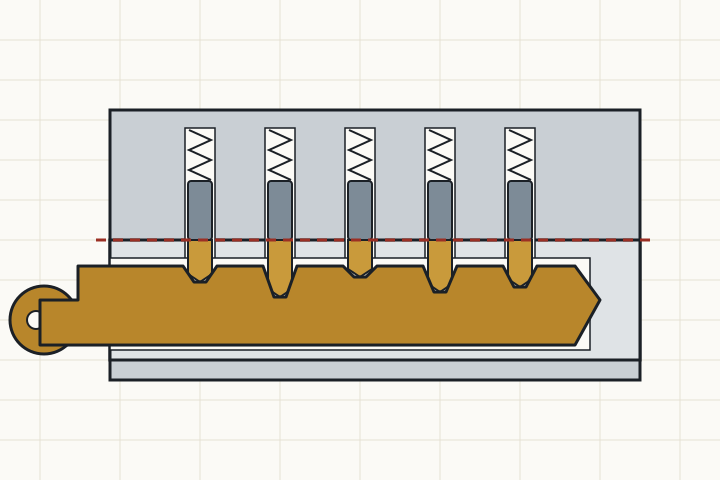
The parts of a cylinder
The pin tumbler cylinder is the lock most people picture when they think of a house key. From outside you see only a round face with a narrow slot in it. Behind that face are two main parts that fit one inside the other.
- The housing, sometimes called the shell, is fixed to the door or to the lock body. It does not move.
- The plug is a smaller cylinder that sits inside the housing and can rotate. The key goes into the plug. When the plug turns, a cam or arm on its back moves the bolt or latch.
An 1865 patent by Linus Yale, Jr., shows the same arrangement in nineteenth-century language: a keyed cylinder that rotates inside a case, a thin steel key, and a wing on the cylinder that moves the bolt. The patent also describes a case that could be screwed in to different depths, so one lock could suit doors of different thicknesses. The details have changed many times since, but the plug turning inside a fixed housing is still the heart of the design.
Everything else in the lock exists to answer one question: is the plug allowed to turn right now?
Pin stacks and springs
The answer is decided by a row of small holes drilled straight through the housing and into the plug. The Lemelson-MIT Program's account of the lock describes the usual arrangement: five or six of these holes, each holding a pair of pins pushed down by a small coil spring.
- The key pin sits at the bottom of each hole, in the plug. It is the pin the key touches. Key pins come in different lengths.
- The driver pin sits on top of the key pin. In the drawing above it is shown in grey steel.
- The spring sits above the driver pin, in the housing, and presses the whole stack down towards the keyway.
Each pair of pins with its spring is called a pin stack. With no key in the lock, the springs push every stack as far down as it will go. Because the holes run from the housing into the plug, each driver pin then sits partly in the housing and partly in the plug. A single pin straddling that boundary is enough to stop the plug turning, in the same way that a bolt dropped through two aligned rings stops them rotating against each other.
The shear line
The boundary between the outside of the plug and the inside of the housing is called the shear line. It is the surface along which the plug would slide if it turned. The plug can rotate only when nothing crosses that line.
The key's job is to lift every pin stack by exactly the right amount. The cuts along the top of a key are of different depths, and each one sits under one pin stack when the key is fully inserted. A deep cut lets a long key pin sit low; a shallow cut lifts a short key pin high. When the key is right, the top of every key pin finishes flush with the outside of the plug, and the bottom of every driver pin finishes flush with the inside of the housing. The split in every stack lies on the shear line, and the plug is free to turn.
Yale's 1865 patent says the same thing in its own terms: each tumbler is made of two pieces, and the key must set the dividing line between them flush with the surface of the rotating cylinder. The patent also describes stops that bring the cylinder to rest with the pin holes lined up again, which is the position in which the key can be put in or taken out.
In one line
A pin tumbler lock opens when the key puts every split between pins on the line where the plug meets the housing, and not before.
Why the wrong key cannot turn it
Each pin stack is an independent check. If a cut on the key is too deep, the key pin above it sits too low and its driver pin still reaches down into the plug. If a cut is too shallow, the key pin is pushed too high and now the key pin itself reaches up into the housing. Either way, one solid pin crosses the shear line and the plug stays put.
That is why the number of pin stacks and the number of possible key pin lengths both matter to a lock's security. Every extra stack is another position where the key has to be right, and the different lengths mean there are many possible keys for any one lock design. A lock maker uses that range to give different doors different keys.
Security standards for door hardware test a great deal more than this, including how a lock stands up to force, torque and repeated use. The guide to choosing home locks explains those ratings. The pin stacks are only the part that decides which key belongs to the lock.
The keyway as a first filter
Before a key reaches the pins, it has to fit the keyway, the slot in the face of the plug. Yale's patent describes a narrow slit cut along the cylinder that takes a thin, flat steel key. Modern keyways are rarely a plain slit. Their outline has ridges and grooves, called wards, and a key blank only slides in if its profile matches.
A patent on restricted key systems, US5176015, explains why that matters: the profile of the keyway decides which blanks can be inserted at all, and controlling who can obtain a particular blank makes unauthorized copies harder to make. The keys and keyways guide covers this in detail.
From wooden locks to pocket keys
The basic idea of pins that a key must lift is very old. The Lemelson-MIT Program dates it to locks used in ancient Egypt around 4,000 years ago. Those locks were large and made of wood.
The modern metal version came from a father and son in the United States. Linus Yale, Sr., ran a lock shop and worked on pin tumbler designs before his death around 1850. His son, Linus Yale, Jr., first turned to locks for banks and safes, and then, according to the same account, patented his cylinder pin tumbler lock in 1861. Its key was small and flat with serrated edges, much like the keys most people carry today. The 1865 patent described above is a later Yale patent for a pin tumbler lock. In 1868 the younger Yale and Henry Towne founded a company in Stamford, Connecticut, to make cylinder locks. He died in December of the same year.
Example: one cut out of place
Worked example
This is an illustration of the principle, not a description of any real lock or key. Picture a cylinder with five pin stacks and two keys that look almost identical.
- The first key is the right one. Each of its five cuts lifts its key pin so that the top of the pin meets the shear line. The plug turns.
- The second key matches the first at four positions. At the third position its cut is a little shallower.
- When the second key goes in, the third key pin rides higher than it should, so its top pokes above the shear line into the housing.
- The other four stacks are perfectly aligned, but that does not help. One pin across the line is enough, and the plug will not turn.
The example shows why a pin tumbler lock is all or nothing. There is no partial opening: every stack has to agree with the key at the same moment.
Where this guide stops
This guide explains the mechanism the way a museum label or a patent drawing does. It does not describe ways to open a lock without its key, and it gives no key cutting measurements. Those subjects are outside the scope of this site, as the editorial policy explains. The next guide compares the pin tumbler with three other mechanisms that answer the same question in different ways.
Next explainer: Wafer, disc and lever locks compared