
Start with the door, not the lock
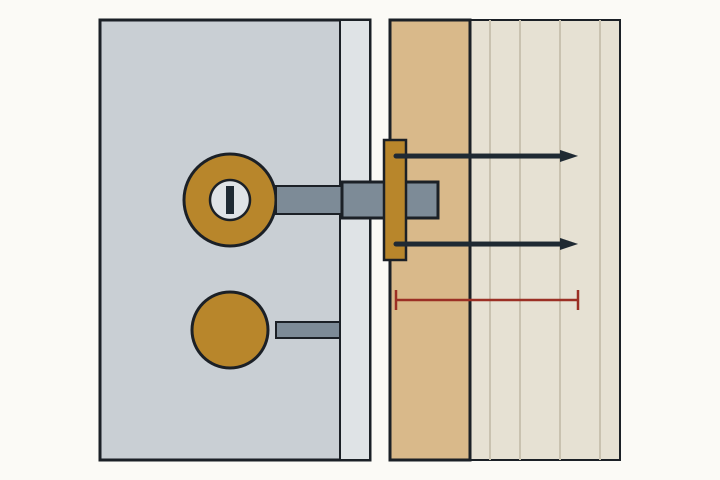
The earlier guides explain how a lock decides which key may turn it. When it comes to keeping a home secure, police crime prevention advice starts somewhere else. The Seattle Police Department's door security bulletin says the most common way of forcing a door with a wooden jamb is to kick it, and that the weakest point is almost always the strike plate, the metal plate on the frame that receives the bolt. On many doors the strike plate is screwed only into the thin trim around the frame, which can tear away. The bulletin also notes a trend towards forcing doors with pry tools.
That is a useful starting point for choosing hardware. A lock with an excellent mechanism still depends on the bolt, the strike plate, the frame and the screws holding them all together. This guide covers the ratings that tell you how a lock or deadbolt performed in testing, and then the parts of the door that the rating cannot cover.
ANSI/BHMA grades
In the United States, performance standards for door hardware are developed by the Builders Hardware Manufacturers Association (BHMA), which its residential program describes as the only organization accredited by the American National Standards Institute (ANSI) to develop and maintain them. The standards are published as the ANSI/BHMA A156 series.
Many of those standards define product grades. BHMA's own summary describes them as grade 1, 2 or 3, with grade 1 the highest, each set by progressive levels of performance benchmarks in the relevant standard. BHMA notes that it is best known for its standards for commercial hardware, which is where these numbered grades are most often seen.
Residential ratings: A, B and C
In 2014, BHMA decided that homes needed their own standards, separate from commercial ones. Its residential program currently covers two:
- ANSI/BHMA A156.39, for residential locksets and latches, such as door knobs and levers;
- ANSI/BHMA A156.40, for residential deadbolts.
Instead of a single grade, a certified residential product gets a separate rating in three categories, each marked C (Good), B (Better) or A (Best) according to how it performed in testing.
| Category | What it measures, as BHMA describes it |
|---|---|
| Security | How well the lock or deadbolt withstands impact and other forced attempts to gain entry. The tests simulate intrusion with blows, excessive torque and similar forces. |
| Durability | How well it keeps working after repeated, long-term use, and how it operates with excess weight hanging on the door. |
| Finish | How well the surface stands up to sun, humidity, salt water, dew and the oils from people's hands without softening, peeling, discoloring or corroding. |
BHMA's answers to common questions give a sense of the testing behind the letters. Under the 2015 edition of A156.39, a lockset has to go through at least 400,000 cycles of opening and closing with a 5-pound load for durability, and its security is judged by a series of 11 tests. Under the 2015 edition of A156.40, a deadbolt is tested to the same number of cycles and has to pass seventeen security tests, one of which loads 1,350 pounds of force against the deadbolt. BHMA's durability page adds that its cycle test can run to one million cycles of unlatching, closing and relatching.
Certification means the product was tested by a third-party laboratory against its standard. BHMA states that products without its residential label are not assured to have been tested and certified that way.
Reading a rating for a particular door
The three letters let you match hardware to the job a door does. BHMA's own example is a bathroom door, where durability may matter more than security or finish. Turning that around, an exterior door is where the security rating matters most, and an exterior door in a coastal or very sunny spot is where finish starts to matter as well.
BHMA also points out practical checks before buying: the thickness of the door and the backset, the distance from the edge of the door to the center of the lock hole. Most hardware adjusts to common sizes, but a lock that does not fit the door cannot perform as tested.
The Summit Police Department's burglary prevention tips add a sober note: no lock, however good, can be truly effective on its own. The rating tells you how the hardware performed in a laboratory. The rest of the door decides how much of that performance you get.
Deadbolts: single or double cylinder
A deadbolt is a separate bolt, thrown into the frame by a key or a thumb turn, in addition to the latch in a door knob or lever. The Summit police tips note that push-button locks on door knobs are easy for burglars to open and advise deadbolts on all exterior doors. The Seattle bulletin goes further and includes the door from a garage into the house.
BHMA's residential program and the Seattle bulletin describe the same two common types:
- Single cylinder: a key on the outside and a thumb turn on the inside. Seattle police suggest these for solid doors where nobody can reach the inside by breaking nearby glass.
- Double cylinder: a key on both sides. Seattle police suggest these where glass next to the door could be broken to reach the lock, and warn never to leave the key in the inside cylinder.
Check local codes before fitting a double cylinder deadbolt
The same Seattle bulletin warns that deadbolts keyed on the inside can be a fire hazard, because the key has to be found to get out, and notes that Seattle's building code does not permit double cylinder deadbolts in apartments or condominiums. Rules differ from place to place. Check your local building and fire codes, and your lease if you rent, before choosing one.
Seattle police also advise that the throw of a deadbolt, the length of bolt that goes into the frame, should be at least 1 inch.
The strike plate and its screws
Because the strike plate is the usual weak point, the Seattle bulletin's main advice is about screws. It recommends:
- replacing the short screws in strike plates and hinge plates on all exterior doors with 3 to 4 inch wood screws that reach the wall stud behind the frame;
- considering a heavy-duty strike plate held by four screws, fitted with the same long screws;
- using long screws in the knob lock's strike plate as well, and at least one long screw in each hinge;
- adding a latch guard over the gap where the latch and bolt meet the frame, against pry tools;
- checking the condition of the wooden frame, and replacing it if it is worn.
The bulletin says that even without a new strike plate, longer screws in the existing one greatly improve a door's resistance to being forced. The drawing at the top of this page shows why: a short screw holds only the trim, while a long one ties the strike plate to the structure of the wall.
Example: checking one front door
Worked example
This is an illustration, not an assessment of any real home. A renter wants to understand the front door of an apartment before asking the landlord about changes.
- The door has a knob with a push-button lock and no deadbolt. Police tips treat that combination as easy to open, so a deadbolt is the first question for the landlord.
- There is a glass panel beside the door. A double cylinder deadbolt is one option the Seattle bulletin mentions for that, but it also warns about fire safety and building codes, so the renter asks what the local code and the lease allow.
- When choosing a deadbolt, the renter looks for a certified residential rating and pays most attention to the security letter.
- The renter also asks whether the strike plate is held by long screws into the stud, since the bulletin calls the strike plate the usual weak point.
Where this guide stops
This guide explains ratings and police advice in general terms. It is not a security survey of your home, it does not recommend products or brands, and it does not override building codes, fire codes, lease terms or the installation instructions that come with hardware. The last guide covers what to do when keys go missing.
Next explainer: What to do after losing your keys